
Washington state sits at the convergence of multiple extraordinary geological processes: ancient Precambrian terranes sutured to a young volcanic arc, Columbia River basalt floods that buried entire landscapes, Cascades volcanoes pumping silica-rich hydrothermal fluids into the rock, and an Ice Age that scraped, sorted, and deposited material across the entire state. The result is a rockhound's playground that spans mountain garnets, desert agates, Pacific coastal treasures, and some of the most spectacular petrified wood on the continent.
What makes Washington particularly compelling is its variety. In a single weekend, you can go from hunting the legendary Ellensburg Blue agates in the high desert east of the Cascades to combing storm-washed Pacific beaches for jasper and fossil wood. The state has something for every collecting style — patient hunters sifting beach gravel, desert explorers scanning basalt-covered ridges, and hikers working Cascade foothills for garnets in metamorphic schist.
This guide covers Washington's top collecting regions in detail, explains the regulatory landscape, and gives you a seasonal strategy so you show up when conditions are right. Already familiar with agate identification? Our guide to identifying agates will help you distinguish Washington's many chalcedony varieties in the field.
Why Washington State is a Rockhound's Paradise
Washington's geological story has several overlapping chapters, each creating different collecting opportunities.
The dominant event in Washington's recent geological history is the Columbia River Basalt Group — one of the largest volcanic eruptions in Earth's history, which flooded much of eastern Washington, Oregon, and Idaho with massive basalt flows between 6 and 17 million years ago. These flows, stacked hundreds of feet thick across the Columbia Plateau, are the source of Washington's most sought-after rocks. As basalt cools, gas bubbles get trapped in the lava, creating vesicles. Silica-rich groundwater later percolates through these vesicles, depositing chalcedony, agate, and jasper nodules over millions of years. Washington's agates — including the famous Ellensburg Blues — formed in exactly this way.
The same basalt flows buried forests, trees, and organic material that were later silicified into petrified wood. The Ginkgo Petrified Forest represents one of the most diverse petrified forests ever documented — over 200 tree species preserved in basalt, including ginkgo trees that no longer grow anywhere on the continent.
The Cascade Range adds another dimension. The Cascades include both active volcanoes (Rainier, Baker, St. Helens) and older metamorphic and plutonic basement rocks. These older rocks — schist, gneiss, and granite — host garnet, tourmaline, and other metamorphic minerals. Hydrothermal systems associated with Cascade volcanism have deposited quartz veins, jasper, and mineralized zones throughout the mountains.
Finally, the Pacific coast provides a constantly refreshed collecting surface. Rivers draining the Olympic Peninsula and Coast Range deliver rock material to the coast, where storm waves sort and polish it on beaches. Every major storm replenishes the beach with agates, jasper, and petrified wood worn smooth by surf action.
Washington Rockhounding Locations at a Glance
| Location | Region | What to Find | Public Access? | Fee? |
|---|---|---|---|---|
| Ginkgo Petrified Forest SP (Wanapum RA) | Kittitas Co. (Vantage) | Petrified wood (designated collecting area) | Yes — Wanapum Recreation Area | Discover Pass required |
| Ellensburg / Kittitas County Gravels | Central WA / Kittitas Co. | Ellensburg Blue agates, chalcedony | Mostly private ranch land | Permission / fee varies |
| Ocean Shores / Pacific Beaches | Pacific Coast / Grays Harbor | Agates, jasper, petrified wood, carnelian | Yes — public beaches | Free (some beach access fees) |
| Saddle Mountains / Frenchman Hills | Central WA / Grant Co. | Jasper, chalcedony, agates, geodes, thundereggs | BLM & USFS open land | Free |
| Puget Sound Beaches | Western WA / Multiple counties | Fossils, glacial erratics, quartz, feldspar | Yes — public tidelands (check ownership) | Free at most public beach accesses |
| Mt. Baker Area | Northwest WA / Whatcom Co. | Almandine garnet, epidote, chlorite schist | USFS land (Mt. Baker-Snoqualmie NF) | Free (Northwest Forest Pass for trailheads) |
| Snoqualmie Pass / Cascades Foothills | Central WA / King & Kittitas Co. | Quartz crystals, jasper, chlorite schist, garnets | USFS — Mt. Baker-Snoqualmie NF | Northwest Forest Pass for parking |
Ginkgo Petrified Forest State Park
Ginkgo Petrified Forest State Park, located near Vantage along the Columbia River in Kittitas County, is one of the most remarkable geological sites in North America — and one of the few Washington state parks where you can legally collect specimens. The park protects a Miocene-age petrified forest where Columbia River basalt flows entombed standing trees approximately 15 million years ago. Silica-laden groundwater slowly replaced the original wood tissue cell by cell over millions of years, creating petrified wood with exceptional structural detail.
What makes Ginkgo extraordinary is the diversity of preserved species. Paleobotanists have identified remains of over 200 different tree species within the park's geological formations — far more than any other known petrified forest. The namesake ginkgo (Ginkgo adiantoides) is particularly significant: modern ginkgo trees (Ginkgo biloba) survive today only in China, having been extinct from North America for millions of years. The discovery of fossilized ginkgo wood here confirmed the genus once thrived in the Pacific Northwest. Other species found include sassafras, elm, spruce, Douglas fir, sweetgum, and dawn redwood.
For collectors, the key location is the Wanapum Recreation Area, a separate unit of the state park adjacent to the main interpretive center. The Washington State Parks website confirms that limited petrified wood collection is permitted in the Wanapum Recreation Area for personal use. The main park area around the interpretive trails is strictly no-collecting — it's a protected geological site. Always check current regulations with the park before your visit, as rules can change seasonally.
What you'll find: small to medium pieces of silicified wood in shades of brown, grey, tan, and occasionally red or orange when iron oxides were incorporated during silicification. Pieces often show preserved wood grain, growth rings, and bark texture. The best pieces show chatoyancy — a silky sheen — in the cross-section. A quality rock hammer helps when working the harder desert ground, though most collecting is surface pickup from weathered material.
The interpretive center at the main park has outstanding displays of the petrified wood varieties found here, organized by species — a great reference for what you might be finding. A visit there before collecting at Wanapum will calibrate your eye significantly.
Ellensburg Blue Agates — Kittitas County
Among all of Washington's geological treasures, the Ellensburg Blue agate stands apart. These small, translucent to semi-transparent chalcedony nodules — pale sky blue to deep cornflower blue — are found in only one place on Earth: the Yakima River valley gravels and surrounding basalt terrain near Ellensburg in Kittitas County. Collectors and lapidaries prize them as one of the rarest agates in North America.
The blue colour comes from the incorporation of trace amounts of iron and the microcrystalline structure of the chalcedony itself, which scatters light similarly to how the atmosphere scatters blue light. The agates are generally small — marble-sized to golf ball-sized — and form as nodules in Columbia River Basalt vesicles. Over millions of years, weathering and river erosion have freed them from the basalt and concentrated them in gravel deposits of the Yakima River drainage.
The collecting challenge: virtually all productive Ellensburg Blue territory is on private ranch land. There is no public land access to known productive gravels. Some local landowners have historically allowed fee-collecting arrangements, but access has become more restricted over the decades as ranch land changed hands. Your best approach is to:
- Contact the Kittitas County Gem Club — local club members maintain relationships with some landowners and may be able to arrange access for visitors.
- Attend gem shows in Ellensburg and the broader Pacific Northwest — dealers who specialize in Ellensburg Blues are often more forthcoming about access options in conversation.
- Check the Yakima River gravel bars on publicly accessible sections — while unproductive compared to the private gravel pits, occasional Blues do wash into public areas.
For identifying Ellensburg Blues in the field: they are typically rounded, waxy-surfaced nodules. Fresh-broken faces show a slightly translucent blue chalcedony, sometimes with faint banding. Hold them wet to sunlight — the blue colour intensifies and transmission is visible. Don't confuse them with blue-grey flint or chert, which are much more common in Washington gravels and are opaque even when wet.
The Mindat.org entry for Ellensburg Blue agates has detailed locality information and collector-submitted specimen photos useful for comparison.
Pacific Coast & Ocean Shores Beaches
Washington's Pacific coast stretches roughly 150 miles from the Strait of Juan de Fuca to the Columbia River mouth, encompassing the Olympic Peninsula's wild outer coast, the Long Beach Peninsula, and the beaches around Ocean Shores in Grays Harbor County. This entire stretch is productive rockhounding territory, with the finds varying by location and season.
Ocean Shores (Grays Harbor County) is the most accessible Pacific coast collecting site for most Washington rockhounds. The long sandy beaches here receive material deposited by rivers draining the Coast Range — primarily the Hoquiam and Chehalis Rivers — which carry agate, jasper, and petrified wood downstream from inland Columbia River Basalt exposures. The best finds appear after major Pacific storms that rework gravel layers buried beneath sand.
What to look for along the Pacific coast:
- Agates: Translucent, waxy-surfaced nodules in white, grey, and amber. Hold them up to sunlight — light transmission distinguishes agates from common chert or quartz.
- Jasper: Opaque red, orange, green, and yellow pieces. Washington's beach jasper often shows beautiful colour patterns and takes an excellent polish — excellent tumbler material.
- Petrified wood: Look for pieces with visible wood grain pattern. Colors range from tan and brown to grey and occasionally red or purple. Surf-polished pieces can be stunning.
- Carnelian: A red-orange variety of chalcedony. Uncommon but found on productive Washington beaches, especially after storms.
The Long Beach Peninsula (Pacific County) is another excellent stretch. The peninsula extends 28 miles — the longest continuous ocean beach in the continental US — and while it's primarily sand, the northern end near Leadbetter Point exposes more gravel and can be very productive after fall and winter storms.
Olympic Peninsula beaches — particularly along the outer coast of Olympic National Park — are spectacular but collecting is prohibited in the national park. Stick to the Quinault and Grays Harbor area beaches outside park boundaries. The Olympic National Park website clearly maps park boundaries where collecting is restricted.
Saddle Mountains & Central WA Desert
The Saddle Mountains and Frenchman Hills of Grant County represent the central Washington desert at its most geologically productive for rockhounds. These low, arid ridges are classic Columbia River Basalt anticlines — gentle upfolds of the basalt layers where erosion has exposed older, more deeply weathered basalt flows that have had the longest exposure to silica-rich groundwater. The result: the vesicles in these ancient basalt exposures are filled with agate, chalcedony, jasper, and occasional geodes.
Access is primarily via BLM land and Washington State DNR parcels in the Columbia Basin. Much of the terrain is open range with minimal infrastructure — four-wheel drive is recommended for accessing the better sites on unpaved tracks. Bring more water than you think you'll need; summer temperatures in this desert frequently exceed 100°F (38°C).
What to find in the central WA desert:
- Thundereggs: Spherical nodules with a chalcedony or agate interior. Washington's thundereggs are smaller and less spectacular than Oregon's famous specimens, but they're present and worth splitting open. The outsides look like dull brown mud balls — don't ignore them.
- Geodes: Similar to thundereggs but with a hollow crystal-lined interior. Calcite and quartz crystals line the cavities. Productive areas near the Saddle Mountains have yielded some very nice geodes.
- Jasper: Red and green jasper nodules and masses occur throughout the basalt exposures. Some pieces show swirling patterns that make excellent cabochons.
- Carnelian: The red-orange form of chalcedony, more common in the warmer, oxidizing desert environment than on the coast. Fine carnelian from central Washington rivals material from much more famous collecting areas.
The BLM Spokane District Office manages much of eastern Washington's public land and can provide current access information and maps for the central basin areas.
Puget Sound Beaches
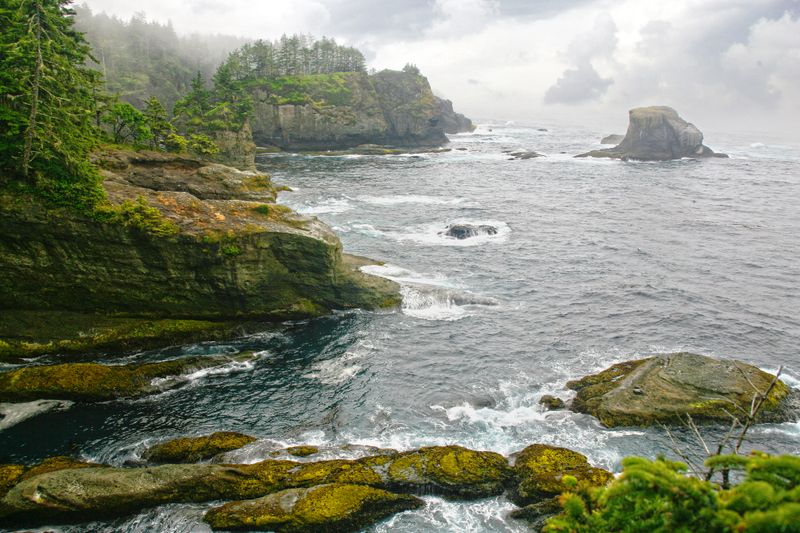
Puget Sound's beaches offer a different kind of rockhounding — driven not by volcanic basalt but by glacial geology. During the last Ice Age, the Cordilleran Ice Sheet advanced south across Washington, covering Puget Sound with glaciers up to a mile thick. As the ice retreated, it deposited a jumble of material scraped from across British Columbia and northern Washington — granite, quartzite, schist, gneiss, marble, and many other rock types — directly onto Puget Sound beaches as glacial till and outwash.
These glacial erratics are the primary attraction on Puget Sound's beaches. You can find beautifully polished pieces of coarse granite, green serpentinite, reddish quartzite, banded gneiss, and occasional pieces of high-quality material — all smoothed by wave action on the sound's beaches. It's more of a "collect beautiful rocks" experience than mineral hunting, but ideal for beginners and families.
More specialized finds include:
- Fossils: Puget Sound's glacial deposits sometimes include Pleistocene fossils — mammoth teeth, bison bones, and mollusk shells from the pre-glacial sea floor. These are uncommon but reported from cliff exposures at several Puget Sound locations. The sediment bluffs above the beaches (particularly in Jefferson and Kitsap Counties) occasionally expose fossiliferous layers after storm erosion.
- Quartz and feldspar: Pure white quartz veins and large feldspar crystals in granite erratics can be extracted with a hammer and chisel.
- Nephrite jade: Very rarely, pieces of nephrite jade — brought down by glaciers from BC sources — are found on Puget Sound beaches. Green, waxy, and extremely tough, jade pieces are unmistakable once you've handled one. Finding a piece is a genuine once-in-a-decade discovery.
Note: Puget Sound beach ownership is complex. Tidelands (the intertidal zone) are separately owned from upland property in Washington, and many tidelands are private even where the upland is public. Always access beaches from established public beach access points. The Washington State DNR Tidelands page explains ownership and access rights.
Mt. Baker Area — Garnets & More
The Mt. Baker area in Whatcom County represents a classic Cascade metamorphic terrane — ancient oceanic crust and sedimentary rocks that were thrust beneath the continent and metamorphosed under high temperature and pressure during the mountain-building events that shaped the Pacific Northwest. These metamorphic rocks are the host for several collector-friendly minerals.
Almandine garnet is the primary target. The schist and gneiss exposed in the Mt. Baker-Snoqualmie National Forest contains almandine garnet in crystals ranging from 3mm to 2cm — small but well-formed dodecahedrons typical of the garnet habit in metamorphic rocks. The garnets occur in mica-rich layers of the schist, often visible as dark red dots against the silvery grey matrix. Road cuts along the Mt. Baker Highway (SR-542) and side roads into the National Forest expose productive schist at several locations.
The Mt. Baker area also yields epidote — a pistachio-green calcium iron aluminium silicate that occurs as prismatic crystals in hydrothermal veins cutting through the metamorphic rocks. Epidote from the Baker area can be gem quality — transparent, with excellent colour. Chlorite schist — deep green, soft, and satiny in texture — makes attractive display material. Occasional pyrite cubes occur in some of the more iron-rich rock layers.
Access is via National Forest roads — Mt. Baker-Snoqualmie National Forest land is open to casual hobby collecting. A Northwest Forest Pass is required for trailhead parking. Avoid collecting within Mt. Baker Wilderness boundaries — wilderness designation prohibits mechanical tools including rock hammers.
Snoqualmie Pass & Cascades Foothills
The Cascades foothills accessible from Snoqualmie Pass (I-90 corridor) offer some of the most accessible backcountry rockhounding in Washington for Seattle-area collectors. The geology here transitions between the Columbia River Basalt flows of the Columbia Plateau to the east and the older metamorphic and plutonic rocks of the Cascades proper.
The Teanaway River drainage in Kittitas County, accessed from US-97 north of Ellensburg, is particularly well known among Washington rockhounds. The Teanaway area exposes a variety of rock types including basalt, blueschist (blue-grey metamorphic rock), and serpentinite — the latter containing occasional chromite and magnetite. The North Fork Teanaway Road (USFS road) provides access to several productive areas on National Forest land.
Along the I-90 corridor itself, the road cuts between North Bend and Snoqualmie Pass expose Cascade metamorphic rocks with quartz veins (sometimes yielding clear to milky quartz crystals), garnet schist, and occasional chlorite-epidote assemblages. Road cut collecting requires extreme caution — always pull completely off the road and watch for traffic. Never collect from highway median barriers or anywhere that requires standing in a travel lane.
The Cascades foothills also offer productive stream panning for gold in creeks draining volcanic and metamorphic terrain. Washington has no restrictions on casual gold panning in most streams on public land with a gold pan. Our beginner's guide to gold panning covers technique and regulations.
Washington State Rockhounding Regulations
Understanding land ownership and regulations is essential before collecting in Washington. The rules differ significantly by land type:
U.S. Forest Service (National Forests)
The Mt. Baker-Snoqualmie, Okanogan-Wenatchee, and Gifford Pinchot National Forests cover significant portions of Washington. On USFS land, casual hobby collecting for personal use is generally allowed without a permit — you may collect reasonable amounts of rocks, minerals, and common invertebrate fossils. "Reasonable" is typically interpreted as up to 25 pounds per day and 250 pounds per year for personal, non-commercial use. Collecting for sale or in commercial quantities requires a permit. Collecting is prohibited in designated wilderness areas, research natural areas, and any area specifically posted against collecting. Always check with the specific National Forest ranger district for current local rules.
Bureau of Land Management (BLM)
Washington has relatively limited BLM land compared to states like Oregon or Nevada, but the Columbia Basin and southeast corner of the state have productive BLM parcels. The same casual collecting rules apply — personal use quantities, no permit required, no commercial collecting without authorization. The BLM Spokane District manages most of Washington's BLM land.
Washington State DNR Lands
The Washington State Department of Natural Resources (DNR) manages millions of acres of state trust lands, natural resource conservation areas, and recreation lands. Surface collecting for personal use is generally allowed on most DNR-managed upland parcels, but check the DNR website for the specific parcel — some areas have collecting restrictions. A Discover Pass ($30/year or $10/day) is required for vehicle access to most DNR recreation sites.
Washington State Parks
Most Washington State Parks prohibit rock and mineral collecting. The notable exception is the Wanapum Recreation Area adjacent to Ginkgo Petrified Forest State Park, where limited petrified wood collection is permitted. Always verify with the specific park before collecting — rules are posted at park entrances and on the Washington State Parks website. A Discover Pass is required for vehicle access to state parks.
National Parks, Monuments & Wilderness
Collecting is strictly prohibited in all national parks (Olympic, North Cascades, Mt. Rainier), national monuments, and designated wilderness areas. Violations can result in significant fines. Do not collect in these areas.
Private Land
Much of Washington's most productive collecting ground — particularly Ellensburg Blue territory — is on private land. Always get explicit written or verbal permission from the landowner before entering. Trespass is a criminal offense in Washington, and agricultural land owners are particularly vigilant about unauthorized access.
Best Seasons to Go Rockhounding in Washington
Fall & Winter (October – February) — Prime Beach Season
The Pacific Ocean storm season is Washington's best time for beach rockhounding. Major storms generate powerful wave action that churns the ocean bottom and redeposits material on beaches — delivering fresh agates, jasper, and petrified wood with each significant storm. The best collecting window is 1–3 days after a major storm, when waves have calmed enough to safely walk the beach but before the new material is buried again. Low tides during morning hours in this season expose the maximum beach area. Ocean Shores, the Long Beach Peninsula, and the outer Olympic coast beaches all produce their best material October through February.
Spring (March – May) — Desert & Mountain Access
Spring is when the central Washington desert becomes accessible after winter. The Saddle Mountains and Frenchman Hills areas are most comfortable in April and May before summer heat arrives. Snow-free mountain roads open in May, giving access to the Mt. Baker area and Cascades foothills. Spring runoff can make creek crossings dangerous but also delivers fresh material to stream gravel bars — a good time for Yakima River drainage hunting (check for Ellensburg Blue access opportunities).
Summer (June – August) — Full Access, Moderate Beaches
All sites are accessible in summer, but beach collecting is at its seasonal low — gentle summer waves don't rework gravel effectively, and fine sand covers most material. Summer is ideal for high-elevation Cascade sites: Mt. Baker garnet hunting, Snoqualmie Pass road cuts, and Teanaway River drainage. Central WA desert sites are productive but extremely hot — plan early-morning starts (before 9 AM) and be out before noon. Carry a minimum of 3L of water per person.
Shoulder Seasons — Best Overall
September and October are Washington's best all-around rockhounding months: the first Pacific storms deliver beach material, mountain sites are still open before snow closes the roads, and temperatures are comfortable everywhere. Early October is particularly productive — storm season just starting, roads still clear, and fewer collectors than the peak summer season.
Essential Gear for Washington Rockhounding
Washington's diverse terrain and unpredictable weather demand versatile preparation. Here's what you'll need:
🔨 Rock Hammer
Essential for Cascade metamorphic sites and desert basalt. The Estwing E3-22P rock pick handles everything from schist to basalt. For finer work — splitting fossil-bearing layers or opening thundereggs — add a smaller crack hammer and cold chisel set. Don't forget eye protection; fresh-broken basalt throws sharp chips.
View Rock Hammers on Amazon →🧺 Rock Tumbler (for beach finds)
Washington's beach jasper and agates are prime tumbling material. A quality tumbler transforms rough beach finds into polished gems. The Lortone 3A and NATIONAL Geographic tumbler are excellent entry-level options for the volume of material you'll collect on a beach trip. See our 2026 rock tumbler guide for full comparisons.
View Rock Tumblers on Amazon →🌧️ Rain Gear & Waterproof Boots
Washington's coastal and mountain areas receive significant precipitation. A quality waterproof jacket and knee-high rubber boots (or waterproof hiking boots) are non-negotiable for beach and creek collecting. The Pacific coast can be cold and blustery even in summer — layers are essential.
View Waterproof Boots on Amazon →Additional essentials for Washington: offline topo maps (cell service is poor in the desert and mountains — download maps in Gaia GPS before leaving), sun protection (central WA desert has extreme UV), and a Northwest Forest Pass ($40/year or $5/day) for USFS trailhead parking. See our full rockhounding gear guide for comprehensive equipment recommendations.
Frequently Asked Questions
What can you find rockhounding in Washington state?
Washington offers exceptional variety: Ellensburg Blue agates (rare translucent blue chalcedony, Kittitas County), petrified wood at Ginkgo Petrified Forest, agates and jasper on Pacific coast beaches, almandine garnets near Mt. Baker, thundereggs and geodes in the central WA desert, quartz crystals in Cascade foothills, and fossils and glacial erratics on Puget Sound beaches.
Where can I find Ellensburg Blue agates?
Ellensburg Blue agates are found in Kittitas County near Ellensburg, primarily in Yakima River valley gravels. The catch: nearly all productive ground is on private ranch land. Contact the Kittitas County Gem Club for landowner access information, attend Pacific Northwest gem shows to buy specimens, or check accessible Yakima River gravel bars on public land sections.
Is rockhounding legal in Washington state?
Yes, with distinctions by land type. Casual hobby collecting is allowed on most USFS and BLM land without a permit. Washington State DNR lands generally allow collecting — check per parcel. Ginkgo Petrified Forest's Wanapum Recreation Area allows limited petrified wood collection. Collecting is prohibited in all national parks, wilderness areas, and most state parks. Private land requires landowner permission.
When is the best time to go rockhounding on Washington's beaches?
Fall and winter (October through February) are the best seasons for Pacific coast beach rockhounding. Pacific storms rework beach gravel and deliver fresh material. Plan to visit 1–3 days after a major storm during a morning low tide. Summer is the least productive beach season — fine sand covers material and gentle waves don't rework gravel.
Are there garnets in Washington state?
Yes. Almandine garnets occur in metamorphic schist in the Mt. Baker area (Whatcom County) and in the Okanogan Highlands of northeastern Washington. They're found on USFS land in the Mt. Baker-Snoqualmie National Forest. Crystals are typically small (3–15mm) but well-formed. Road cuts along the Mt. Baker Highway and forest roads expose garnet-bearing schist.
Get weekly guides from RockhoundGuide
New state guides, gear picks, and collecting tips. No spam. Unsubscribe anytime.